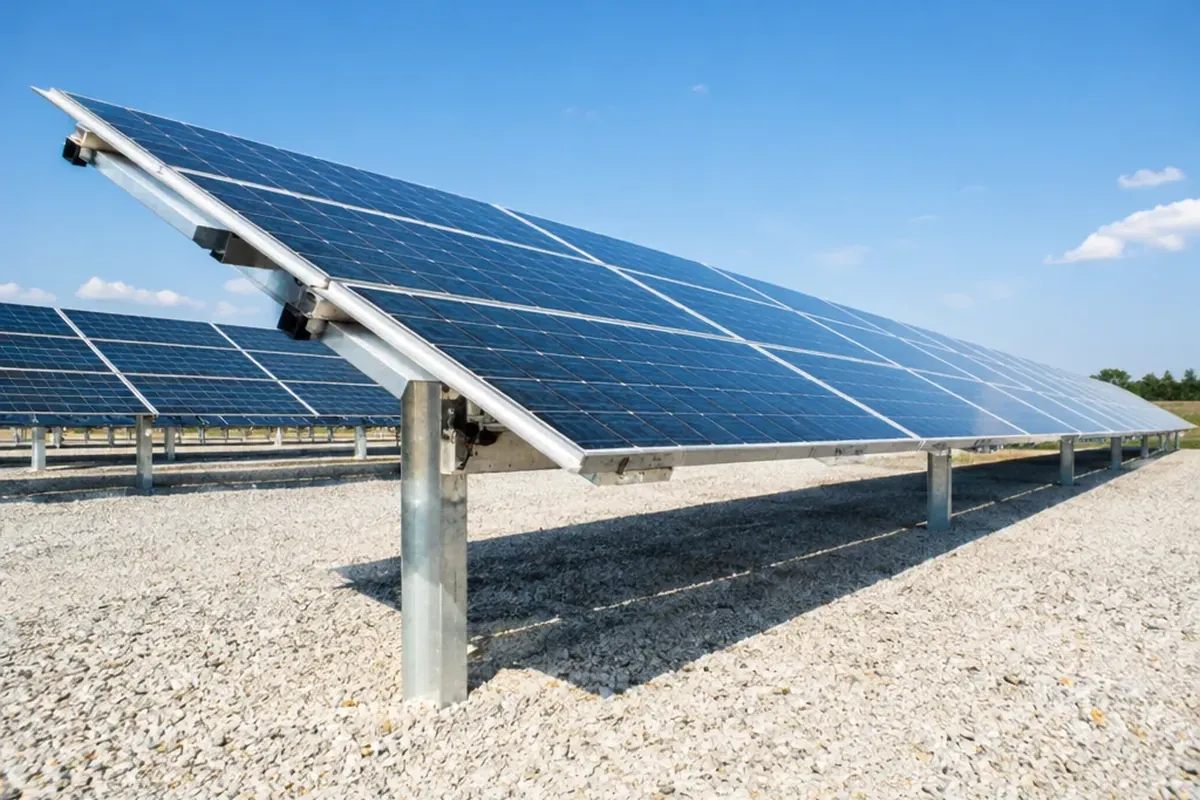
Bifacial solar panels make electricity from sunlight on the front and reflected light on the back. That second surface can add meaningful output over bright ground with generous clearance, but it can add very little on a dark roof where the panel sits close to the surface.
How bifacial solar panels turn reflected light into electricity
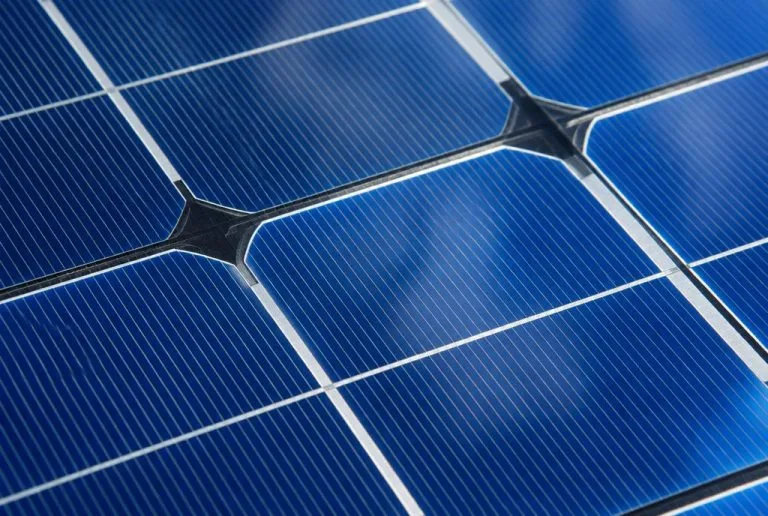
A conventional monofacial panel collects light on its front only. Its rear has an opaque polymer backsheet, so light reaching that side cannot be used. A bifacial module replaces that opaque rear with a transparent surface, usually a second sheet of tempered glass. The cells can then collect light reflected upward from the ground or nearby surfaces.
The added electricity compared with an otherwise identical monofacial system is called bifacial gain, defined as a percentage of extra energy.
The bifaciality factor describes the rear side’s conversion efficiency relative to the front under standard test conditions. A factor of 0.80 means the rear can deliver 80% of the front-side output under equal illumination. In a real installation, the rear receives far less light than the front.
Ground reflectivity determines how much rear-side light is available
The key site variable is albedo, the share of incoming light a surface reflects. It runs from 0 for a completely absorbing surface to 1 for a completely reflecting one.
| Surface below the array | Typical albedo | What it suggests for a bifacial rear side |
|---|---|---|
| Dark soil or asphalt | 0.10–0.17 | Limited reflected light |
| Grass | 0.20–0.25 | Some reflected light |
| Dry sand | 0.30–0.40 | Stronger rear-side opportunity |
| Concrete | 0.25–0.55 | Potential varies widely by finish and color |
| Fresh snow | 0.80–0.90 | Very high reflected-light potential |
In Chennai, white stones with 49.9% albedo and a mounting height of 1.3 meters produced rear irradiance equal to 25.5% of front irradiance. In Cologne, gravel with 28% albedo and a 1.5-meter mounting height produced 13.8%.
Glass-glass construction can improve durability but adds weight
Nearly all bifacial modules use tempered glass on both sides. Compared with a polymer backsheet, that glass-glass construction resists moisture entry and UV degradation more effectively. Typical annual degradation is about 0.4–0.5% for bifacial dual-glass modules, compared with about 0.7% for polymer-backsheet panels.
Glass does not burn, so dual-glass modules can have a Class A fire rating, while monofacial backsheet panels are listed as Class C. Many glass-glass bifacial panels also carry a 30-year linear power warranty, versus 25 years for backsheet panels. The symmetric glass sandwich can reduce the risk of microcracks as well.
Glass-glass construction adds roughly 2–4 kilograms per panel; a 54-cell residential module is typically about 22–24 kilograms.
Cell technology also affects rear-side capability. Older bifacial PERC cells are around 0.70 in bifaciality, modern n-type TOPCon cells about 0.80, and HJT cells about 0.85–0.95. Independent Kiwa PVEL testing found average bifaciality of 69% for PERC, 75% for TOPCon, and 87% for HJT. None of the more than 50 TOPCon constructions tested reached the 80% printed on their data sheets.
Bifacial versus monofacial panels: compare the whole installation
| Question | Bifacial panel | Monofacial panel |
|---|---|---|
| Where does it generate? | Front side plus reflected light at the rear | Front side only |
| Typical annual degradation | About 0.4–0.5% | About 0.7% for polymer-backsheet panels |
| Physical trade-off | Usually 2–4 kg heavier | Typically lighter |
| Strongest fit | Raised, well-spaced arrays over reflective surfaces | Standard roof layouts with little rear exposure |
| Cost question | Mounting layout can add system cost | Usually the simpler benchmark |
Bifacial modules are now about 5–15% more expensive than monofacial modules and can approach price parity in large-volume markets. However, taller mounting, wider row spacing, and tracking can raise overall system costs. On a standard dark tile roof, the realistic rear-side gain is often only 3–6%, while the premium can be 10–20%.
When bifacial solar panels are most likely to pay off
Bifacial technology is strongest on elevated, well-spaced ground arrays and on tilted or raised roof structures over reflective ground. It also suits agrivoltaic projects, where the clearance needed for farm equipment helps reflected light reach the rear of the modules.
Fixed ground systems over natural vegetation produced about 7% bifacial gain in NREL measurements and generally remain below 10% unless the ground becomes more reflective. Conventional ground installations commonly deliver 6–15% more annual energy. Over snow, white gravel, or reflective membranes, gains can reach 20–30%.
Rear irradiance changes substantially when a panel is raised from about 0.4 meters toward 2 meters. By contrast, a low monitor-style installation with about 7 inches of clearance produced only about 2–4% gain on clear days. In a field test, artificial reflectors with 70% albedo increased daily energy by up to 6.2% compared with natural albedo.
Use panel size and daily production to plan a realistic system
Many residential panels measure about 67.8 by 44.6 inches, weigh 46–47 pounds, and are rated at 420–440 watts. Larger 144-cell commercial modules measure 2,278 by 1,134 millimeters, weigh about 37.7 kilograms, and are rated at 580–600 watts. The largest 700-watt class reaches 2,384 by 1,303 millimeters and about 38 kilograms.
On average, a 400-watt panel produces about 2 kWh per day. Twelve such panels therefore produce about 24 kWh per day under average solar conditions.
Common myths can lead to the wrong bifacial choice
Myth: Every bifacial installation gains 30%
High gains are possible over snow, white gravel, or reflective membranes, but they are not a baseline. Natural-vegetation ground arrays measured about 7% in one NREL result, while the common field range for conventional ground systems is 6–15%.
Myth: A bifaciality factor of 0.80 means 80% more energy
It means the rear side can convert equally illuminated light at 80% of the front side’s efficiency. The rear normally receives only a fraction of the front-side light, so the added system energy is much smaller.
Myth: Bifacial panels are only for hot, sunny places
Snow reflects about four times more light than summer grass. In Ontario, monofacial panels lost about 16% of annual output to snow cover in winter, while bifacial panels lost at most about 2% in the comparison.
Myth: Better modules remove the need to examine system cost
The rear-side opportunity depends on the installation. Added height, spacing, and support structure can decide whether a higher-output module produces a better project result.
Frequently Asked Questions
What is the size of a solar panel?
A common residential panel is about 67.8 by 44.6 inches, weighs 46–47 pounds, and is rated at 420–440 watts. Commercial modules are substantially larger: a 144-cell 580–600-watt model is about 2,278 by 1,134 millimeters and weighs about 37.7 kilograms.
What is the price of a bifacial solar panel in India?
Reported retail prices, including GST, are about ₹19–₹37 per watt. One 630-watt n-type TOPCon bifacial module is listed at ₹11,907, or ₹18.90 per watt; a 740-watt HJT module is listed at ₹21,756, or ₹29.40 per watt.
Why is it hard to sell a house with solar panels?
It can be harder when the system is leased or covered by a power-purchase agreement because the buyer must take over the contract and qualify with the provider. Buyers may also ask about roof penetrations, maintenance costs, and the age and condition of the roof beneath the panels.
How much energy do 12 solar panels produce per day?
At an average of about 2 kWh per day from one modern 400-watt panel, 12 panels produce about 24 kWh per day. Actual production depends on available sunlight and the installation.
What is the biggest drawback of solar panels?
The largest single drawback is the up-front cost: a residential system typically costs $15,000–$30,000 before incentives. Solar panels also generate no electricity at night and little in heavy cloud; a grid-tied system automatically shuts down during an outage unless backup equipment is included.
Is 10 kW enough to run a house?
A 10-kW system produces about 14,500 kWh per year on the U.S. average, enough to cover the electricity needs of most average American households. Whether it is enough for one home still depends on that household’s annual consumption.