Learning how to clean solar panels safely starts with a less obvious question: do they actually need cleaning? For most homes, a gentle rinse-and-brush routine once or twice a year is enough, but pollen, bird droppings, dust, and local conditions can change that. Check your system’s production first; the goal is to restore light to the glass without risking a fall, scratched coating, or water damage.
When dirty panels are likely costing production
Routine dust accumulation reduces output by about 1–5% in typical U.S. climates. In high-soiling regions, annual losses can reach 7%. Those are useful benchmarks, not a reason to climb onto the roof on a fixed date: compare recent production with your system’s usual pattern before deciding to clean.
Some deposits deserve quicker attention. At five utility-scale plants in North Carolina, peak-season pollen reduced performance by up to 15%, and rain did not fully restore it. A single bird dropping can reduce output power by up to 23.8%. After a long dry spell, a heavy pollen season, or visible bird mess, a sustained production drop is a practical signal to investigate.
How often to clean solar panels in your location
Most residential systems benefit from cleaning once or twice a year. Every six months is a common rule of thumb. Panels in high-dust, coastal, or heavily polluted locations may need attention every 3–4 months. Let production data and visible buildup refine the calendar rather than treating any interval as mandatory.
| Situation | Useful starting point |
|---|---|
| Typical residential site | Clean once or twice yearly. |
| Dusty, coastal, or polluted site | Consider cleaning every 3–4 months. |
| Output drops after drought or pollen | Inspect from the ground and consider cleaning sooner. |
| Heavy snow | Do not assume cleaning is the answer; snow can block 90–100% of expected winter generation in heavy-snowfall regions. |
The potential gain is not uniform. A California study found average daily soiling loss of 0.051%; during a 145-day summer drought, that accumulated to 7.4%. In contrast, cleaning a typical 5 kW system halfway through that drought was estimated to add only about $20 in electricity. Conditions and safe access matter as much as the dirt itself.
Stay on the ground whenever you can
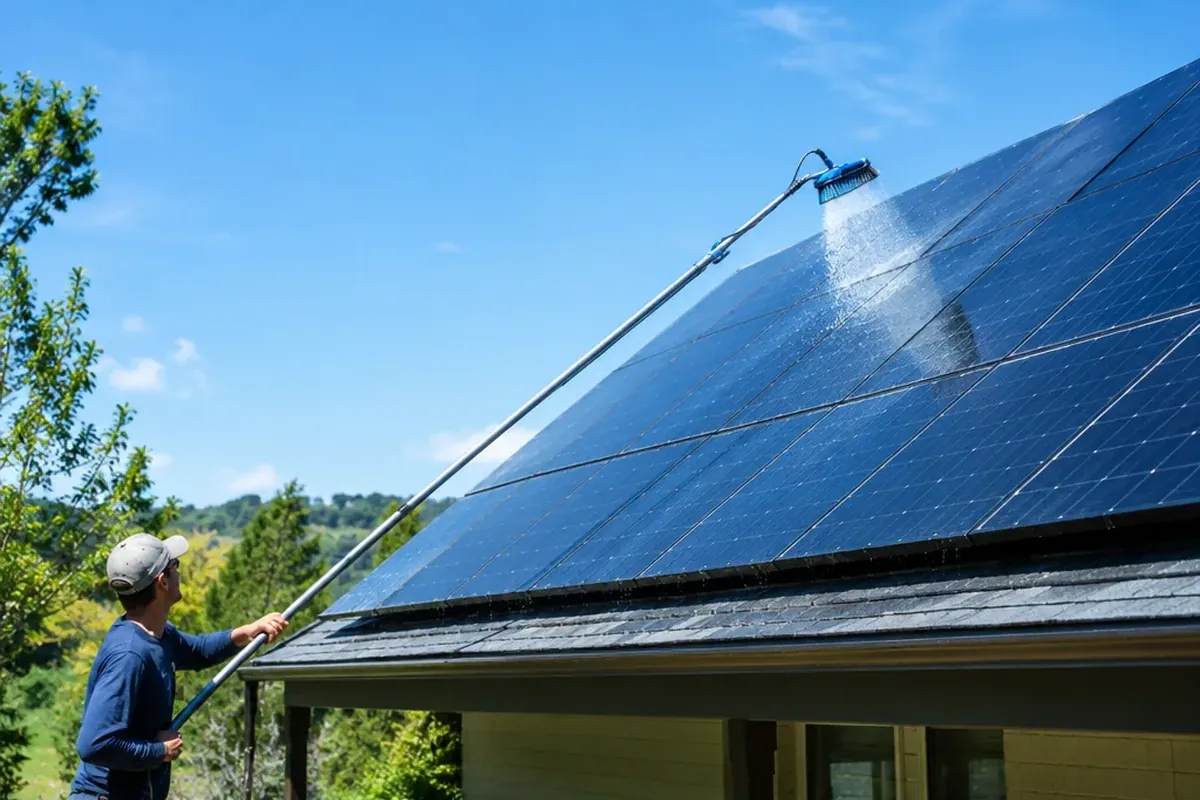
Ground-level cleaning is the safer choice. A low-pressure hose and a water-fed pole with a soft brush can reach many arrays without ladders. Never walk directly on panels: it can irreparably damage the cells and frame. Do not clean alone on a roof. If the panels can only be reached from the roof, hire a trade specialist. Anyone who goes up needs non-slip footwear and, on steep roofs, a safety harness.
Pick early morning, late evening, or an overcast day, when the glass is cool. Cold water on hot glass can cause thermal shock and crack the surface. Moderate spring and fall conditions make this work easier, but the panel temperature matters more than the month.
Clean panels gently, in five deliberate steps
- Follow the manual and shut the system down. Use the inverter shutdown procedure specified for your system before cleaning. Manufacturer instructions take priority if they differ from general advice.
- Rinse away loose grit. Use a garden hose at low pressure. High-pressure equipment can force water past frame seals and damage glass or anti-reflective coatings.
- Use clean, low-mineral water where possible. Deionized water is ideal because it dries without mineral spots. Tap water is an acceptable fallback, but lower dissolved-mineral content is better.
- Lift stubborn dirt without scrubbing. Use a soft-bristle solar panel cleaning brush, microfiber cloth, or soft cellulose cloth in gentle circular motions. For bird droppings, let the wetted spot soak for 1–2 minutes first.
- Rinse thoroughly and let the glass dry. Rinse off loosened dirt and any permitted cleaning product immediately. Air-dry the panels or use a soft squeegee.
Build a solar panel cleaning kit around soft tools
A useful solar panel cleaning kit is simple: a low-pressure hose, deionized water if available, a soft brush on an extension pole, a clean microfiber or soft cellulose cloth, and an optional soft squeegee. Professional cleaners use water-fed poles with deionized water and soft bristles so they can work from the ground rather than climb a ladder.
For routine dust, water is usually the best solar panel cleaner. A specialized, biodegradable solar panel cleaning solution that is formulated for anti-reflective coatings may be appropriate for stubborn grime only if the panel manual allows it. REC permits a mild biodegradable washing-up liquid for stubborn marks when it is rinsed off immediately, while other manufacturer guidance prohibits surfactants. Check the manual before adding any product.
Five cleaning myths that can leave panels worse off
| Myth | What the evidence and guidance say |
|---|---|
| “More pressure cleans better.” | Pressure washers can damage glass and coatings, force water past seals, and void warranties. |
| “A scouring pad is fine for dried-on spots.” | Abrasive pads leave micro-scratches that accumulate and permanently reduce the light reaching cells. |
| “Shampoo is mild enough.” | Shampoo and body wash contain surfactants similar to dish detergent and should not be used. |
| “Dish soap is always safe.” | A University of Turku study found dishwashing detergent reduced light transmittance; glass cleaned with it transmitted less light than dirty glass. |
| “Rain always does the job.” | Rain may remove loose dust, but it did not fully restore pollen-related performance in the NREL observations. |
That is why a product marketed as a solar panel cleaner is not automatically appropriate. Avoid shampoo, body wash, harsh chemicals, blades, metallic sponges, steam cleaners, and pressure washers. In the Turku study, dish detergent left transmittance about 3% below the best-suited tested agents, likely because residue remained after rinsing. Do not use Dawn dish soap or any other dish detergent unless your panel manufacturer explicitly permits it.
When “solar panel cleaning near me” is the safer search
Look for qualified local help when panels cannot be reached from the ground, the roof is steep, production remains low after visible dirt is addressed, or you suspect damage. Cleaning can be combined with an inspection, but the two are different tasks. One guide recommends professional inspections every 5–10 years while the system performs as expected; Hanwha Q CELLS calls for annual installer checks that components are secure, corrosion-free, and properly connected. After winter, a trained professional should inspect for broken glass, detached frames, and warped modules.
Frequently Asked Questions
What is the 20% rule for solar panels?
The 20% rule is a system-sizing guideline, not a cleaning threshold. It can mean designing panels to produce about 20% more electricity than a home uses, or planning for 80% coverage with a margin. That buffer can absorb real-world losses such as the 2–7% soiling range.
What is the 33% rule in solar panels?
In U.S. fire-code guidance under IRC R324.6.2, panels covering 33% or less of a roof’s plan-view area need an 18-inch clear ridge setback. Above 33%, the setback is 36 inches. The rule lets firefighters ventilate the roof along the ridge without walking on live panels; it is not a cleaning rule. In system design, “33%” can also mean sizing the panel array up to about 33% above the inverter’s AC rating.
Can we wash solar panels with shampoo?
No. Shampoo contains surfactants similar to those in dishwashing detergent. They can leave residue and should not be substituted for a panel-approved method.
Should I use soap to clean solar panels?
Usually, no. Plain deionized water and a soft brush are the routine standard. Some manuals permit mild biodegradable washing-up liquid for stubborn marks, but others forbid surfactants, so the manufacturer’s instructions decide.
Is Dawn dish soap OK for solar panels?
Do not treat Dawn as a default option. Dish detergent can leave a film and may conflict with manufacturer guidance. Use it only if your specific panel manufacturer explicitly permits it.
What is the best thing to clean your solar panels with?
Purified or deionized water with a soft, nonabrasive brush is the best general approach. Work when the panels are cool, use low pressure, and clean from the ground whenever possible.