
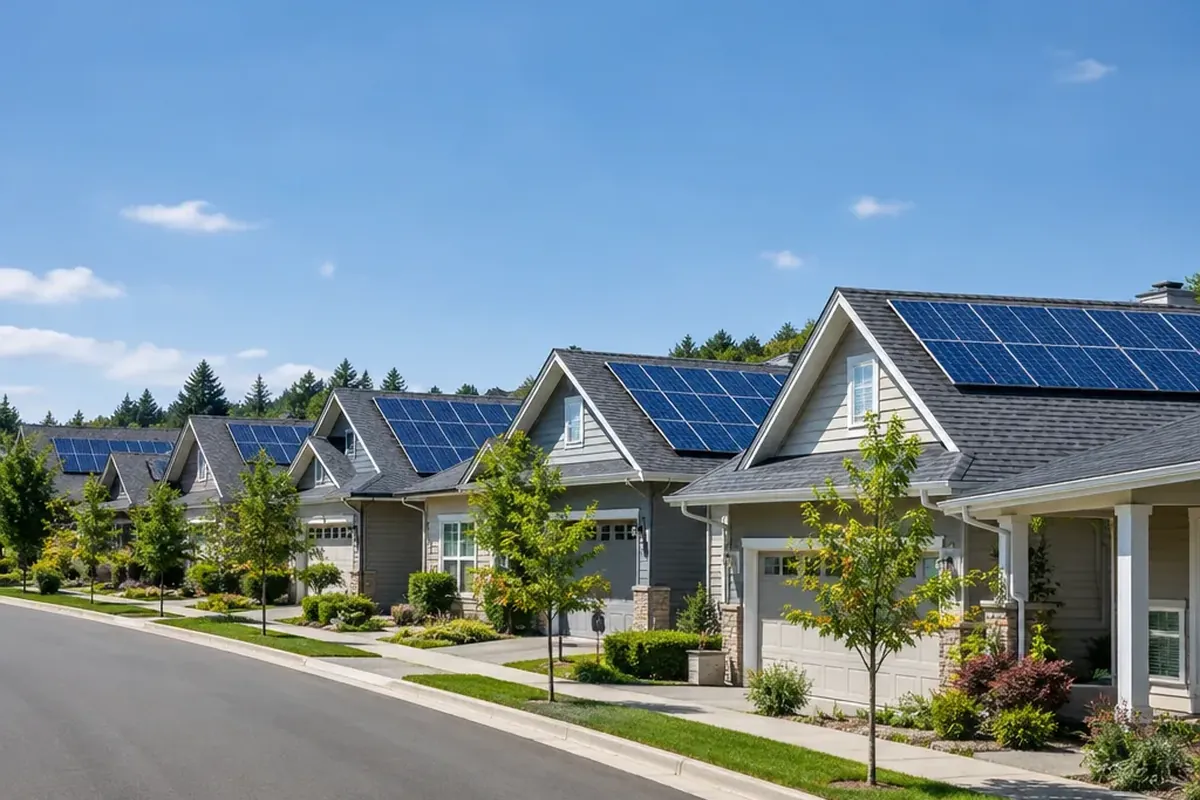
Solar leasing means you rent a rooftop solar system from a solar company for a fixed monthly payment, with little or no upfront cost. The company owns the panels; you use the electricity they produce. A Power Purchase Agreement (PPA) works similarly, but you pay per kilowatt-hour (kWh) generated instead of a flat fee. Both models make it easy to start, but they bind you to contracts of 20 to 25 years, often with annual price increases and transfer rules if you sell your home.
How Solar Leasing and PPAs Compare: Monthly Rent vs. Power Contracts
In both solar leases and power purchase agreements (PPAs), the solar provider retains full legal ownership of the physical system. The homeowner owns none of the hardware.
The core difference lies in billing structure:
- Solar Lease: Works like renting equipment. The homeowner pays a fixed monthly payment regardless of weather or system output. If the system underproduces, the customer still owes the full monthly lease payment.
- Solar PPA: Works like an electricity supply contract. The customer purchases the energy generated by the system at a set rate per kWh. Because generation peaks in summer and drops in winter, monthly PPA payments fluctuate seasonally. The provider absorbs the risk of underproduction; if the panels produce less power, the homeowner pays less.
According to EnergySage data, the average PPA rate sits roughly 22% below the national average residential electricity rate. Consumer Reports estimates that going solar saves an average homeowner approximately $60,000 over a 25-year system lifespan. A cash purchase brings the highest lifetime savings, followed by a solar loan; a lease brings the lowest.
| Feature | Solar Lease | Power Purchase Agreement (PPA) | Direct Purchase / Solar Loan |
|---|---|---|---|
| Equipment Owner | Solar company | Solar company | Homeowner |
| Monthly Billing | Fixed monthly payment | Variable payment (per kWh produced) | Fixed loan payment or $0 (cash purchase) |
| Production Risk | Borne by homeowner (full rate due) | Borne by provider (pay only for output) | Borne by homeowner |
| Tax Credit Beneficiary | Solar provider (commercial Section 48E) | Solar provider (commercial Section 48E) | Homeowner (Section 25D through 2025) |
Tax Credits, Escalators, and the True Cost of Payments
In third-party ownership models, the solar provider claims the federal tax credit rather than the homeowner. The residential clean energy tax credit under Section 25D (30%) expired for homeowners for installations completed after December 31, 2025. According to the IRS, the installation date counts for this credit, not the payment or signing date. For leased systems, however, providers can still claim the federal commercial investment tax credit under Section 48E, provided the installation enters service before the end of 2027.
Providers build this into their prices. Tesla, for example, claims the Section 48E commercial credit directly and passes savings to customers through lower monthly lease payments. Many lease agreements, however, include annual payment increases known as escalators.
Tesla solar leasing has a 3% annual escalator over its 25-year term. Compared with a flat rate, a 3% escalator can add thousands of dollars over 25 years. In California, escalators typically range from 1% to 3% a year, and the California Public Utilities Commission (CPUC) urges caution with higher rates. Not every lease has an escalator; for example, Sugar Hollow Solar in North Carolina offers a Palmetto LightReach lease agreement without an annual escalator. Some providers also offer prepaid leases: you pay for the whole term upfront, often at a discount, and still receive maintenance and monitoring.
Common Myths and the “20% Rule” for Solar Panels
The “20% rule” can mean three different things in residential solar:
- The NEC 120% Busbar Rule (NEC 2023, Section 705.12(B)(2)): Often confused with a “20% rule,” this National Electrical Code requirement dictates that 125% of the solar inverter’s continuous output current rating plus the main supply breaker rating cannot exceed 120% of the electrical panel’s busbar rating. For instance, in a 200-amp busbar with a 200-amp main circuit breaker, 120% of the rating equals 240 amps. Subtracting the 200-amp main breaker leaves 40 amps, limiting the solar inverter to a maximum continuous output of 32 amps (since 32 A multiplied by 125% equals 40 A). This rule applies specifically when the solar breaker sits at the opposite end of the busbar from the main breaker, alongside mandatory warning labels.
- System Sizing Buffers: Installers frequently apply a rule of thumb recommending that arrays be sized roughly 20% larger than a household’s annual electricity consumption to account for seasonal sunshine variations, localized shading, and equipment degradation over time.
- Manufacturer Degradation Thresholds: Most panel manufacturers guarantee that panels will retain at least 80% of their nameplate production capacity after 25 years—capping allowable degradation at 20% over that operating timeframe.
What Are the Drawbacks of Leasing Solar Panels?
A lease saves you the upfront cost, but it comes with several trade-offs.
The biggest drawback is giving up the tax credit. On an 8 kW system at $3.36 per watt ($26,880), a 30% credit would have been worth $8,064. And because you never own the equipment, a leased system never reaches a break-even point for you.
Property value is another drawback. According to SolarReviews, purchased solar systems raise home values by an average of 6.9%, while leased systems do not raise them at all. In some areas, assessors still count leased panels in property tax assessments, so your tax bill can rise even though you do not own the system.
Many lease customers also pay two bills each month: the lease payment plus a utility bill when the system does not cover all their use. In ConsumerAffairs reports, a New York customer said the lease payment rose by $17 a month every year without any savings. Repairs can also drag on: one customer needed 20 phone calls and nine months to get even a partial repair, while the full lease payment remained due.
Why Is It So Hard to Sell a House with Solar Panels?
A solar lease adds contract steps to a home sale that can cause delays. Because the leasing company owns the equipment, it usually files a UCC-1 financing statement that surfaces during title searches and must be cleared prior to sale.
To finalize a sale, the seller must either buy out the remaining contract balance or have the buyer assume the agreement. Assumption requires the buyer to pass a credit check conducted by the solar provider. If the buyer fails the credit check, the transfer is rejected—even if mortgage lenders have approved the home loan. Furthermore, Fannie Mae guidelines mandate that monthly solar lease payments be counted toward the buyer’s debt-to-income (DTI) ratio unless the lease contract transfers to the home itself, which can jeopardize buyer loan approval. Buyers are also often hesitant to assume agreements with 10 to 20 years of remaining payments and built-in escalators.
Real estate agents advise initiating lease transfer procedures 60 to 90 days before an anticipated closing date, as the provider transfer review typically requires two to six weeks. In regional markets, specific documentation governs transactions; Texas real estate transactions require TREC Form 52-1 (Addendum Regarding Fixture Leases) to establish handling of the lease contract. Buyout disputes can also arise: in Oregon, one homeowner found that the provider’s written buyout quote differed by roughly $31,000 from the figure in the contract.
How to Get Out of a Solar Lease
Under the Federal Trade Commission (FTC) Cooling-Off Rule, consumers retain a three-business-day right to cancel door-to-door contracts in writing without penalty. Certain state consumer statutes and select installer contracts expand this cancellation window to between 14 and 30 days. After that, the contract is binding, and five legal ways out remain:
- Full System Buyout: The homeowner purchases the system outright from the provider. Buyout valuations during the first five years typically range between $15,000 and $40,000, depending on system size and remaining contract length. Under Tesla solar leasing rules, buyouts are permitted after year five, priced at the lower of a contractually scheduled figure or fair market valuation.
- Contract Transfer upon Sale: The lease agreement transfers to a qualified homebuyer who passes the solar company’s credit check.
- Prepaying Remaining Lease Terms: The customer pays off all remaining monthly payments across the term. This ends monthly billing, but the solar company retains ownership of the equipment.
- Early Contract Termination: The homeowner terminates the contract early and pays termination fees, which commonly range from $10,000 to $40,000.
- Contract Rescission for Fraudulent Misrepresentation: Homeowners can pursue formal legal cancellation in cases of fraudulent misrepresentation.
Why People Are Getting Rid of Their Solar Panels
The most common reason for removing panels is a roof replacement. Taking the modules off and reinstalling them costs between $2,800 and $4,800.
Roof leaks at mounting points also prompt panel removals, although repairing the leak points is generally more cost-effective than removing the entire system. The warranty for roof leaks can be limited to the first few years, so check this point in the contract.
Utility rate changes also affect economics. In California, NEM 3.0 reduced solar export compensation rates, lowering bill offsets and extending payback periods. If the installer goes bankrupt, the system is left without customer service, although the panel and inverter manufacturers’ warranties still apply separately. In 2024, the Consumer Financial Protection Bureau (CFPB) reported that promised savings often failed to materialize, and dealer fees in solar loans inflated borrowing costs by 30% or more over cash pricing.
Is Solar Still Worth It? Payback Periods and Market Shifts
U.S. electricity prices have risen by an average of 50% over the past five to six years, and solar protects against further increases.
Without the 30% federal tax credit, a standard 7 kW system priced at $3.00 per watt ($21,000 gross) achieves payback in roughly 11 years under national average electricity rates of 18.2 cents per kWh. In regions with higher utility rates:
- California: At an average of 32.6 cents per kWh, a comparable system pays back in about 6 to 10 years without the credit, depending on the estimate. The end of the credit added about 2 to 3 years compared with the earlier 5 to 7 years.
SEIA and Wood Mackenzie project that total US residential solar installations will contract by approximately 23% in 2026, with an increasing share of customers opting for third-party leases and PPAs. Shares vary by state: in California, leases made up just 3% of new residential systems in 2025, compared with 42% for PPAs and 55% for ownership.
Critical Questions to Ask Solar Leasing Companies Before Signing
The U.S. Treasury recommends checking the contract length, the monthly payment, all fees, exit fees, and whether payments increase over time. Ask these questions before you sign:
- Rate Escalator Terms: Does the agreement contain an annual escalator? What will the exact monthly payment be in year 10 and year 20?
- Insolvency Protocols: Who assumes system monitoring, service, and warranty coverage if the solar company enters bankruptcy?
- Production Guarantees: Does the contract guarantee specific output, and will the provider financially reimburse shortfalls if the system fails to produce agreed energy levels? (Tesla, for instance, guarantees 95% system availability over the lease term, evaluated in two-year increments.)
- Tax Credit Pass-Through: How does the provider reflect the Section 48E commercial tax credit in monthly lease pricing?
- Hardware Replacement: Because inverters generally last around 10 years while panels last at least twice as long, does the agreement confirm that inverter replacements are covered by the provider?
- End-of-Term Options: Standard lease terms allow for contract renewal (often at lower rates), purchasing the equipment at fair market value, or free removal by the provider. (Tesla contracts allow a 5-year lease renewal at a revised rate, fair market purchase, or system removal at the customer’s expense.)
The U.S. Treasury warns that sales pitches promising “guaranteed energy savings” or claiming the federal government will pay for your solar panels are almost always a scam. In California, CPUC regulations require solar leasing companies to provide written disclosures detailing pricing, maintenance responsibilities, transfer protocols, and end-of-term disposal prior to contract signing.
Frequently Asked Questions
What are the drawbacks of leasing solar panels?
The primary drawbacks include missing out on federal tax credits—such as the $8,064 incentive on an 8 kW system—and achieving lower lifetime energy savings compared to owning hardware. Leased panels do not raise your home’s value (purchased panels add an average of 6.9%), often mean two monthly bills, can include annual escalators, and can complicate selling your home.
What is the 20% rule for solar panels?
The phrase commonly refers to the National Electrical Code 120% rule (NEC 2023, Section 705.12(B)(2)), which limits solar backfeed so that 125% of the inverter’s continuous output current plus the main breaker rating does not exceed 120% of the electrical busbar capacity. It is also used as a sizing guideline to oversize systems by 20% to account for weather, shading, and degradation, or to reference warranty terms guaranteeing no more than 20% module power loss over 25 years.
How to get out of a solar lease?
Homeowners have a three-business-day cooling-off period under FTC regulations to cancel door-to-door agreements. After that window, exit options include buying out the system ($15,000 to $40,000 in the first five years), transferring the agreement to a qualified homebuyer, prepaying remaining payments across the term, paying early termination fees ($10,000 to $40,000), or pursuing legal contract rescission in cases of fraudulent misrepresentation.
Why are people getting rid of their solar panels?
The most frequent cause is roof replacement, which requires disconnecting and remounting panels at an expense of $2,800 to $4,800. Other common reasons include addressing roof leaks at mounting points, installer bankruptcies that leave systems without direct customer support, reduced solar export credits under utility tariffs like California’s NEM 3.0, and unfulfilled energy savings projections.
Why is it so hard to sell a house with solar panels?
Leased panels require the buyer to pass provider credit checks and assume remaining lease obligations, which Fannie Mae factors into buyer debt-to-income ratios unless the lease transfers to the property. In addition, the leasing company files a UCC-1 financing statement that places a lien on title records, requiring a transfer process that takes two to six weeks and can cause closing delays.
Is solar still worth it?
For many homeowners, yes. Without the federal residential credit, a 7 kW system at $3.00 per watt pays for itself in roughly 11 years at average U.S. electricity prices; in California, higher prices shorten payback to about 6 to 10 years. U.S. electricity prices have risen by an average of 50% over the past five to six years. Owning usually saves more over time than leasing.